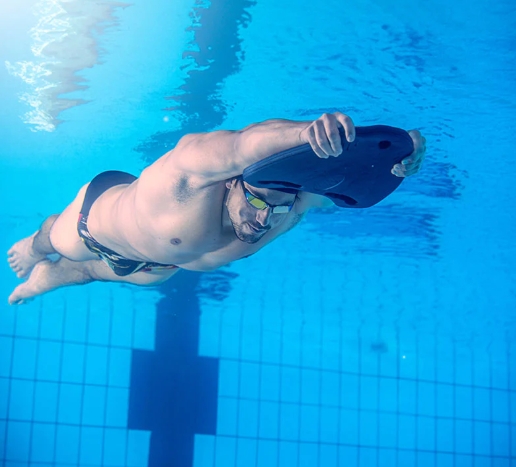
How to Use a Kickboard and Pull Buoy?
Beginner's Guide to Better Swimming
If you're new to swimming or looking to level up your skills, two essential tools—kickboards and pull buoys—can be game-changers. These simple yet powerful accessories help build strength, improve technique, and make your time in the pool more effective. In this guide, we'll break down exactly how to use them, so you can start swimming stronger and more confidently.

What Are a Kickboard and Pull Buoy Used For?
Let’s start with the basics. A kickboard is a flat, rectangular floatation device that helps you isolate and strengthen your leg muscles. By holding it while kicking, you take your arms out of the equation, forcing your legs to do the work—great for improving kick technique and building endurance.

A pull buoy, on the other hand, is a foam or rubber cylinder that you between your thighs. It keeps your lower body afloat, allowing you to focus on your arm strokes and upper-body strength. Using a pull buoy can help you develop a smoother, more powerful pull while also improving your body position in the water.

How to Use a Kickboard: Step-by-Step
1. Get into the Right Position
Hold the kickboard with both hands, gripping the sides or the front handle (if it has one). Your arms should be straight but relaxed, with the board resting just below your chest. Lean forward slightly, so your shoulders are over the board—this helps keep your body horizontal and prevents your legs from sinking.
2. Start Kicking
There are two main kicks to practice with a kickboard:
- Freestyle Kick: Keep your legs straight but not stiff, and kick from the hips in a flutter motion. Aim for small, quick kicks just below the surface—no big splashes!
- Breaststroke Kick: Bend your knees, bringing your heels toward your butt, then push your feet out and together in a "frog-like" motion. Make sure to squeeze your legs together at the end for maximum propulsion.
3. Focus on Your Body Position
Keep your core engaged and your hips high to avoid sagging in the middle, which can cause lower back strain. Look straight down at the bottom of the pool to keep your neck in a neutral position.
Pro Tips for Using a Kickboard
- Start with short distances (25-50 meters) and gradually increase as your legs get stronger.
- If your arms get tired, take a break and shake them out—remember, the focus is on your legs!
- Avoid gripping the board too tightly; a relaxed grip helps prevent shoulder tension.

How to Use a Pull Buoy: Step-by-Step
1. Position the Pull Buoy
Place the pull buoy between your upper thighs, just below your hips. Squeeze it gently to hold it in place—you shouldn't need to clamp down hard. The buoy should feel secure but comfortable.
2. Start Swimming with Focus on Your Arms
With the buoy keeping your lower body afloat, your arms take the lead. Depending on the stroke:
- Freestyle/Backstroke: Focus on a long, extended reach, pulling through the water with a high elbow. Rotate your shoulders to bring your arm back into the water smoothly.
- Butterfly: Use a strong, coordinated pull with both arms, keeping your body undulating slightly to generate power.
- Breaststroke: Perform a wide, circular pull with your hands, followed by a quick recovery as you bring your arms back in front.
3. Maintain a Strong Core
Even though the buoy is doing some of the work, keep your core engaged to maintain a straight, horizontal body position. This helps you swim more efficiently and prevents your legs from sinking.
Pro Tips for Using a Pull Buoy
- If the buoy slips down, adjust it higher up between your thighs—proper placement is key!
- Start with shorter sets (100-200 meters) and gradually increase as you get used to the sensation.
- Pay attention to your breathing: sync your breaths with your strokes to stay steady and avoid rushing.

Common Mistakes to Avoid
With the Kickboard
- Kicking Too Deep: If your feet are splashing a lot, you're probably kicking too deep. Keep kicks near the surface for better efficiency.
- Hunching Over: Don't let your shoulders round forward—keep your back straight and your body in a long line.

With the Pull Buoy
- Squeezing Too Hard: This can tense up your legs and make swimming feel awkward. A light squeeze is all you need to hold the buoy in place.
- Neglecting Body Rotation: Even with a pull buoy, rotating your hips and shoulders helps you generate more power in your strokes.

Using Kickboard and Pull Buoy Together
Once you're comfortable with each tool separately, try using them together for a full-body workout! For example:
- Do a kickboard set to warm up your legs, then switch to a pull buoy set to work your arms.
- Use the pull buoy while practicing drills that focus on your stroke, then use the kickboard to reinforce proper leg technique.
Conclusion
Incorporating a kickboard and pull buoy into your swim routine is a surefire way to build strength, improve technique, and become a more efficient swimmer. Remember, the key is to start slow, focus on proper form, and gradually increase your intensity. Whether you're training for a race or just want to feel more confident in the water, these tools are here to help you make the most of every stroke.
So grab your gear, jump in the pool, and start practicing—your best swim is just ahead!
Got questions about these tools or other swim gear? Leave a comment below, and I’ll help you out!

About us
HuiYiHao GROUP is an export-oriented entity group company. Focus on the production and sales of the industry's best EVA Foam sheet, EVA Children's Toys,Cosplay Material Series,EVA Swimming Accessories, EVA Packaging Series and EVA Finished Product Series, Paper Box, Yoga Accessories.
The predecessor Shenzhen Huiyihao Packaging Materials Co., Ltd. was founded in 2003 in Shenzhen, Guangdong Province, mainly for domestic first-line brands and world-renowned enterprise customers. Our factory and foam factory together cover a total area of 51,000 square meters, with a staff of 150 people. Our products include foam sheet materials, children's toys, and outdoor goods. As long as it involves EVA, EPE, or sponge products, we can produce them. You can visit our store and find a product that interests you.
Does Kickboard Swimming Help Lower Back Pain?
Is Swimming with a Float Good Exercise?